
Research Projects
This page presents an overview of our group's research, highlighting various projects within our four main research directions and any relevant publications.
A Smoothed Particle Hydrodynamics (SPH) Framework for Coupled Hydromechanical Problems
We work on developing meshfree methods such as SPH to improve their features and capabilities with a focus on constitutive models as well as coupled hydromechanical and multiphysics frameworks amenable to the SPH method to properly model a number of problems in geotechnics including embankment collapse, landslides, debris flows, and seismic loading and soil liquefaction.
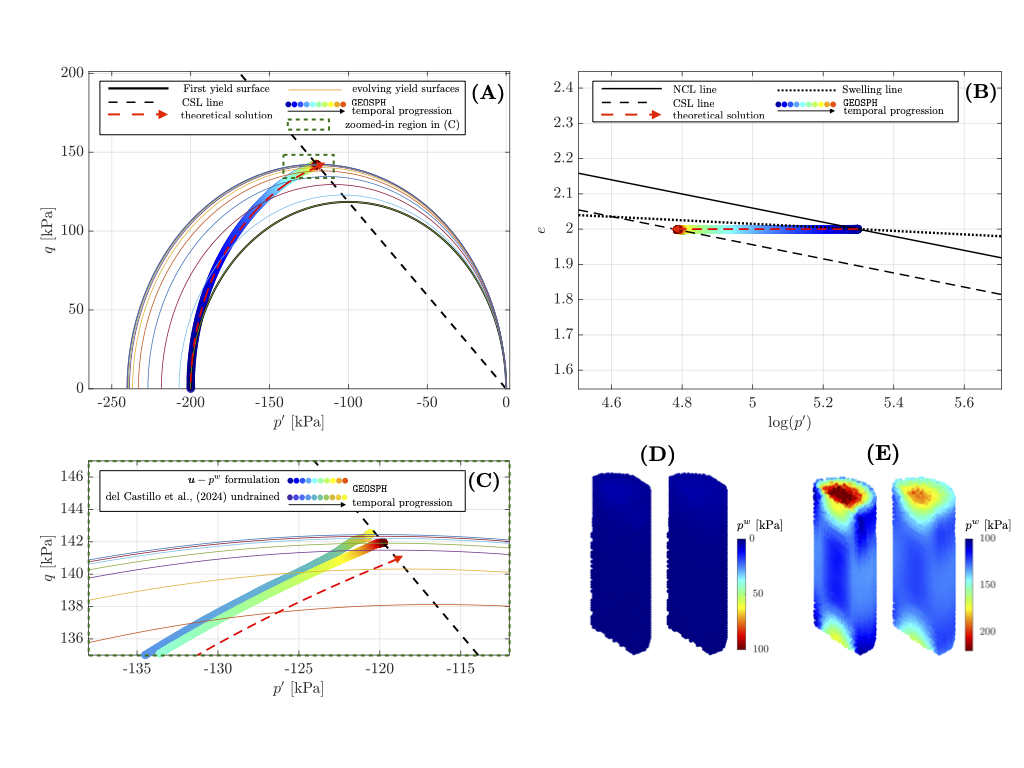
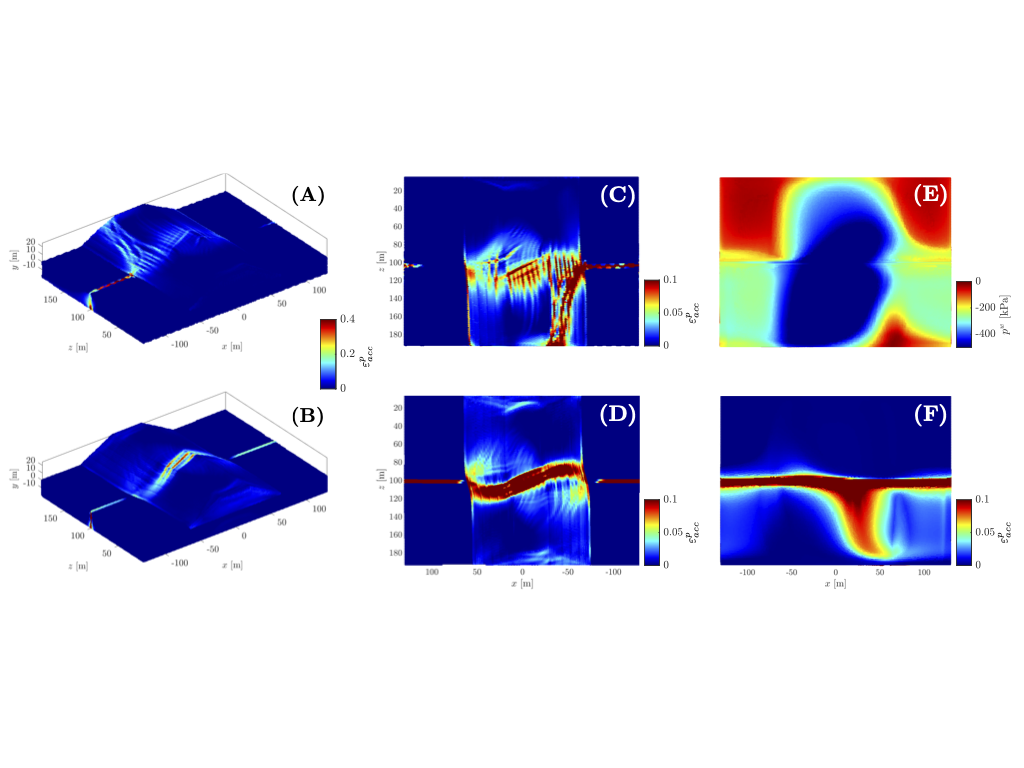
We investigate how the coupled solid–fluid response of saturated geomaterials should be represented under rapid loading and failure. Using critical-state constitutive models, we compare simplified undrained formulations with fully coupled approaches that explicitly resolve pore-pressure evolution. Our results clarify when an undrained approximation can reproduce the mechanical response and when hydro-mechanical coupling becomes essential, particularly in the context of retrogressive landslides. This work provides a foundation for extending computational meshfree modeling toward static and dynamic soil liquefaction, flow failure, and post-failure mobility, with applications to tailings-dam failures, and other rapidly evolving geohazards.
E. M. del Castillo, R. I. Borja, & A. H. Fávero Neto. "A Coupled u–pw SPH Formulation for Hydromechanical Modeling of Retrogressive Landslides: Comparison with a Penalty-Based Approach." International Journal for Numerical and Analytical Methods in Geomechanics, 2026.
🔗 View Publisher DOI 📄 Download PDF
E. M. del Castillo, A. H. Fávero Neto, J. Geng, & R. I. Borja. " SPH framework for drained and undrained loading over large deformations." International Journal for Numerical and Analytical Methods in Geomechanics, 2024.
🔗 View Publisher DOI 📄 Download PDF
Fault-propagation Folding and Accretionary Wedge Mechanics
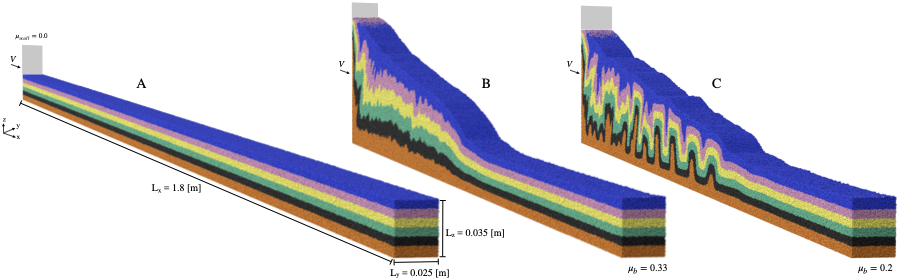
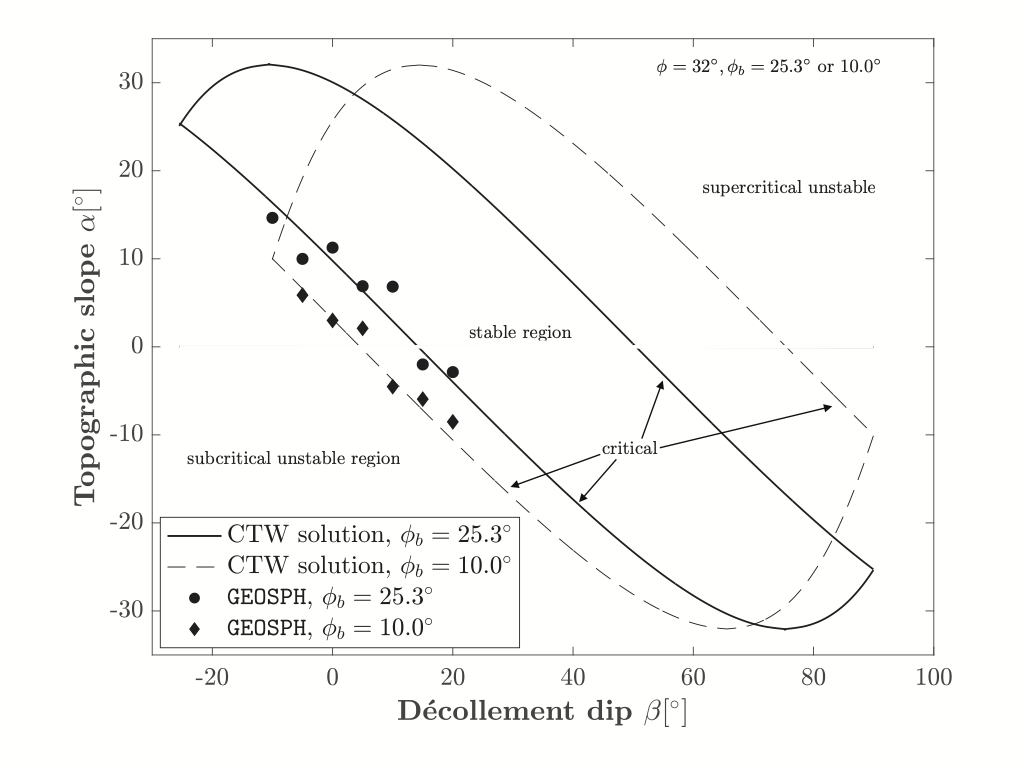
Our work investigates how strain localization and fault propagation organize deformation at tectonic scales and ultimately shape large geological structures. Using high-resolution three-dimensional discrete-element models, we study the development of accretionary wedges and show how evolving stress states produce complex sequences of thrust nucleation and propagation. We study the directionality of fault propagation, orientation evolution, and the deformation precursors leading to eventual persistent faults. These results connect the mechanics of strain localization and individual fault growth to the emergence of large-scale thrust networks and the progressive structural evolution of accretionary systems.
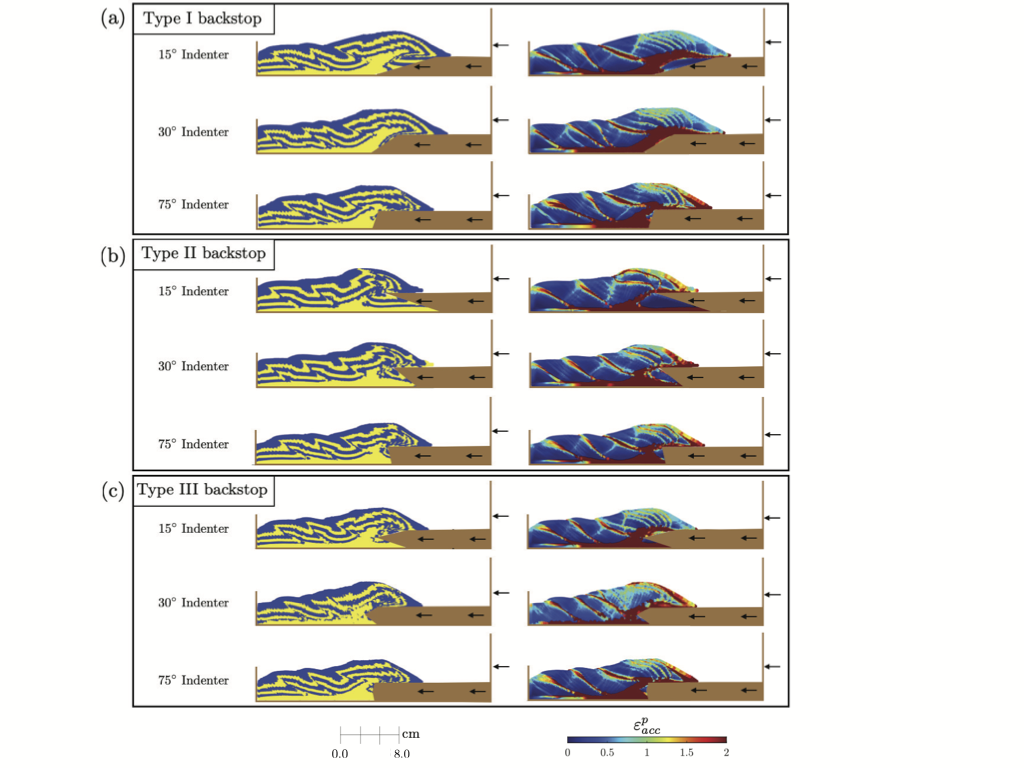
We extend this mechanics-based perspective to the development of doubly vergent wedges, using large-deformation continuum-based simulations to reproduce the contrasting evolution of prowedges and retrowedges and reveal how faulting, uplift, surface deformation, and interactions with basal boundaries collectively control wedge architecture. Beyond frictional tectonic systems, we have also worked on Lagrangian finite-element approaches for salt tectonics, important in the context of petroleum basins, allowing the long-term evolution and the stress state of highly deformable geological materials and structures to be accurateley modeled within a solid-mechanics framework.
🔗 View Publisher DOI 📄 Download PDFE. M. del Castillo, B. Ferdowsi, A. Rubin, & B. Schoene. "Strain localization patterns and thrust propagation in 3-D discrete element method (DEM) models of accretionary wedges." Tectonics, 2023
🔗 View Publisher DOI 📄 Download PDFE. M. del Castillo, A. H. Fávero Neto, & R. I. Borja. "A continuum meshfree method for sandbox-style numerical modeling of accretionary and doubly vergent wedges." Journal of Structural Geology, 2021
🔗 View Publisher DOI 📄 Download PDFE. M. del Castillo, A. H. Fávero Neto, & R. I. Borja. "Fault propagation and surface rupture in geologic materials with a meshfree continuum method." Acta Geotechnica, 2021
🔗 View Publisher DOI 📄 Download PDFG. Scovazzi, O. Colomés, N. Abboud, M. Veveakis, E. M. del Castillo, D. Valiveti, & H. Huang. "A blended transient/quasistatic Lagrangian framework for salt tectonics simulations with stabilized tetrahedral finite elements." International Journal for Numerical Methods in Engineering, 2021
🔗 View Publisher DOI 📄 Download PDF
Modeling Volcanic Caldera Collapses
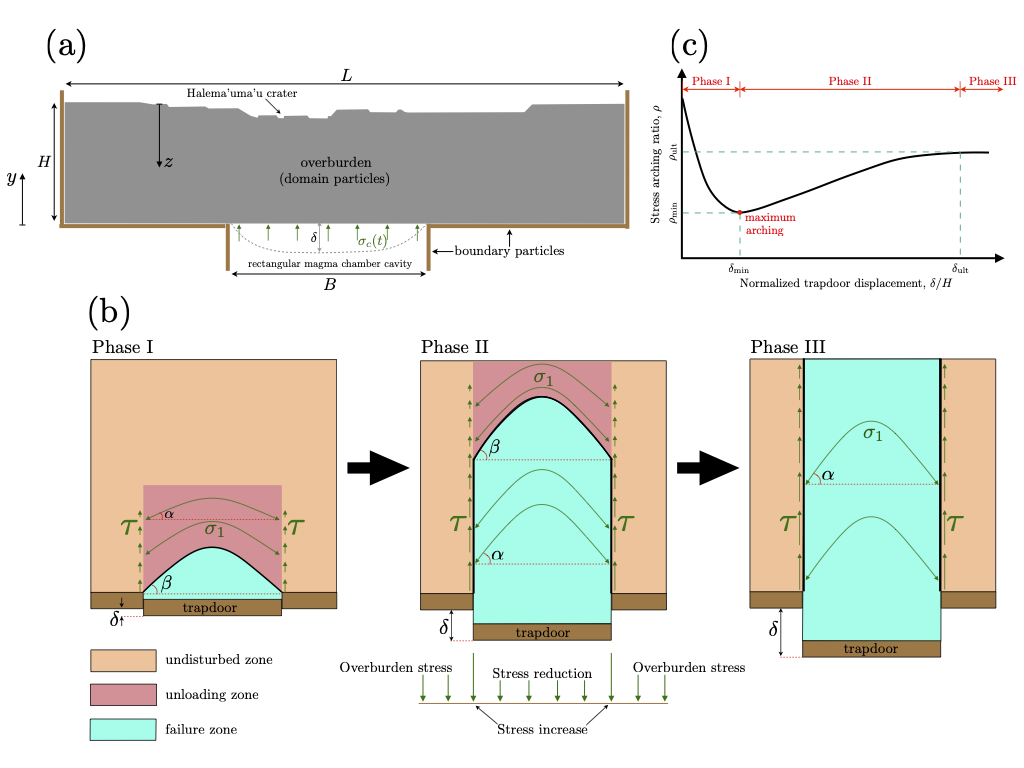
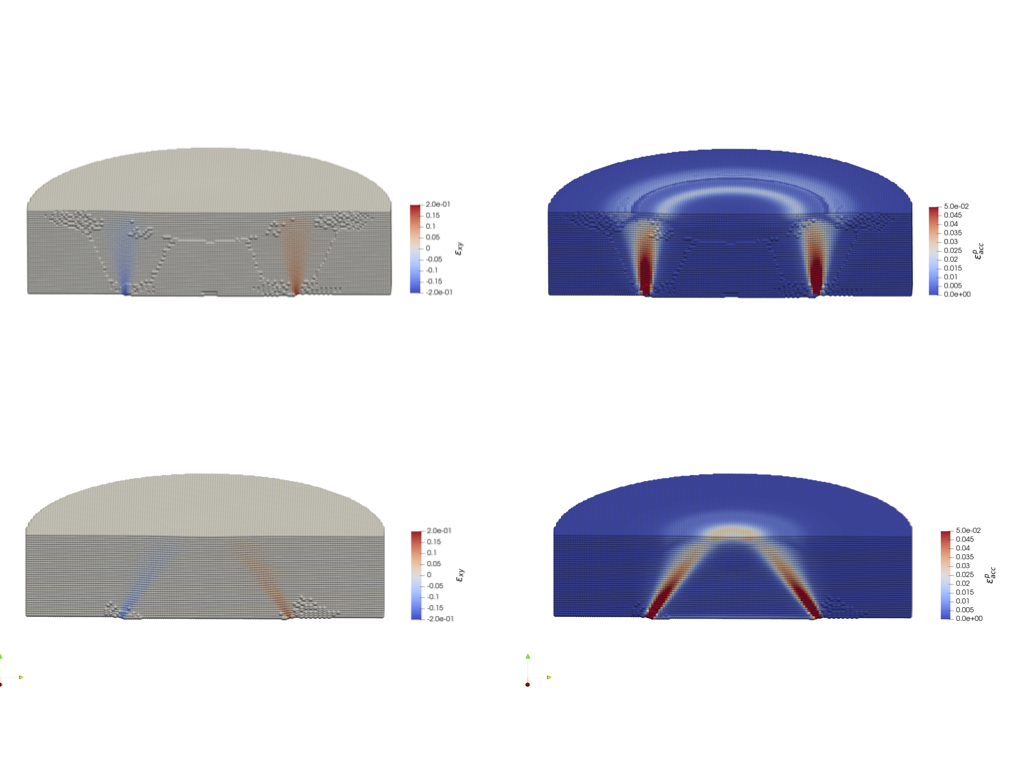
We use large-deformation computational mechanics to investigate pressure-driven volcanic caldera collapse, focusing on the well-constrained 2018 Kīlauea event. Our models capture the evolution from magma-reservoir depressurization to crustal deformation, stress arching strain localization, and eventual collapse without prescribing the motion of the collapsing block.
The simulations reproduce the critical pressure change associated with the 2018 Kīlauea caldera collapse as understood from geodetic measurements. By using an elastoplastic constitutive modeling approach, our work underlines the importance of including inelastic deformation within the subsiding piston-like block, even in the case of non-localized distributed deformation, as opposed to fully elastic solutions. The results highlight how pressure-driven loading fundamentally controls caldera-collapse mechanics and demonstrate the potential of large-deformation methods for modeling volcanic deformation and failure.
🔗 View Publisher DOI 📄 Download PDF
Mechanistic and Data-driven Constitutive Modeling
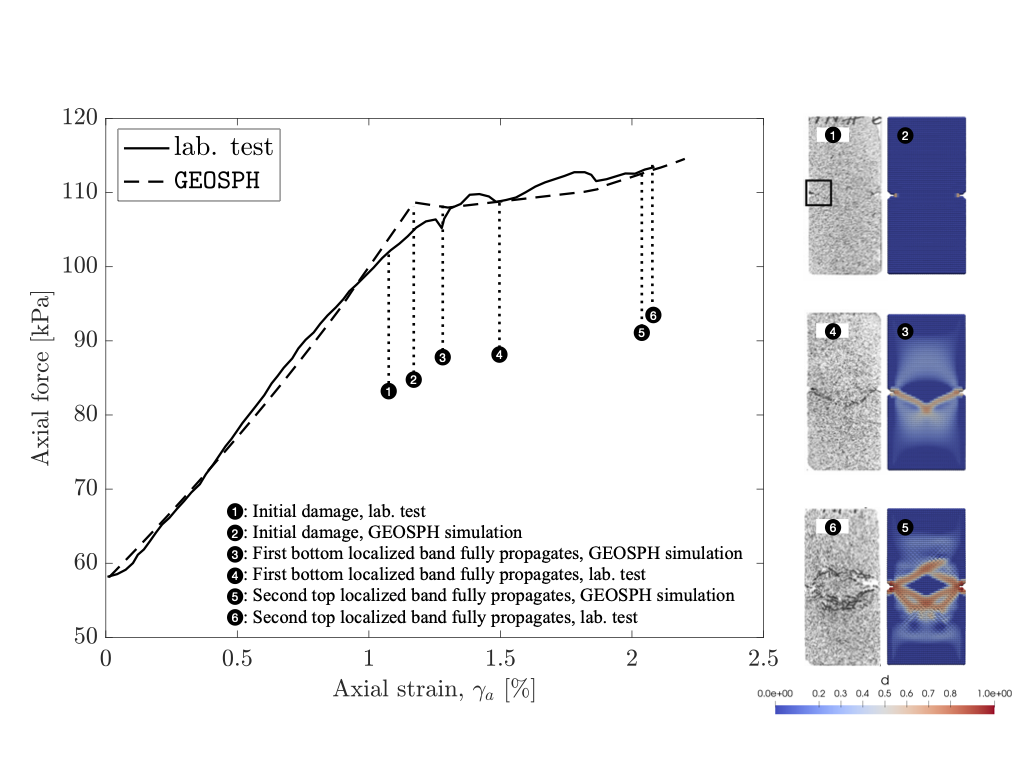
A particular focus is the formation and propagation of compaction bands in porous rock via a nonlocal kernel-based continuum damage model which we introduce, where damage driven by grain crushing produces narrow zones of intense volumetric deformation. We use the discontinuous bifurcation criterion, based on the determinant of the acoustic tensor, to interpret and explain the orientations of the resulting compaction bands after they emerge, correctly capturing behavior seen in experiments. We investigate the mechanics controlling their nucleation and evolution, and how these localized structures alter porosity, permeability, and subsurface fluid migration, with direct implications for fluid injection, storage, and containment.
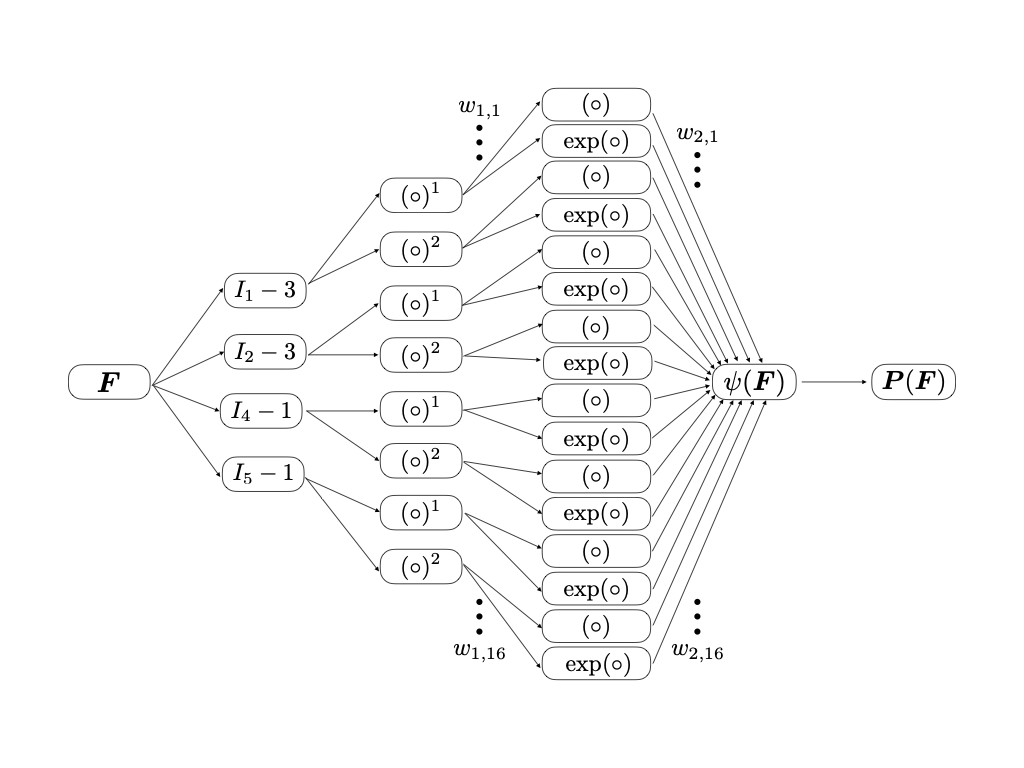
More broadly, accurately predicting these processes requires constitutive models capable of representing the complex behavior of geological materials. Yet many popular constitutive models are phenomenological and most involve some degree of user bias. In ongoing work, we use so-called constitutive neural networks, which offer a thermodynamically consistent framework to automatically discover the best fitting transversely isotropic hyperelastic model for shale, given available experimental material-testing data, providing a data-driven approach for capturing its strongly anisotropic mechanical response while retaining a mechanics-based constitutive structure.
E. M. del Castillo, J. Geng, & E. Kuhl. "A constitutive neural network-discovered transversely isotropic hyperelastic-damage model for shale rock." [In preparation], 2026.
E. M. del Castillo, J. Geng, & R. I. Borja. "A nonlocal kernel-based continuum damage model for compaction band formation in porous sedimentary rock." Computational Mechanics, 2025.
🔗 View Publisher DOI 📄 Download PDF
Variational Phase-Field Method for Dynamic 3D Cracks
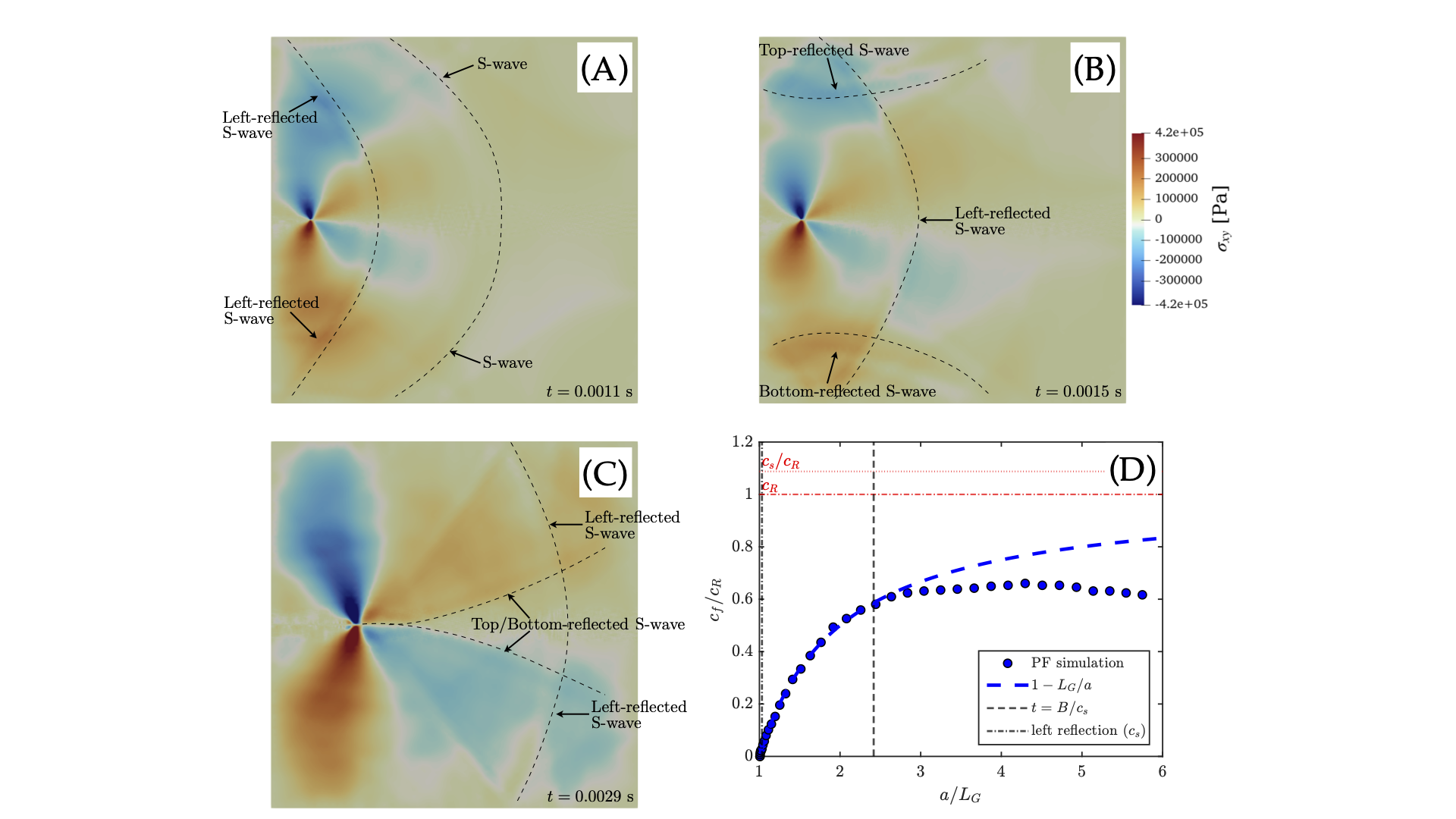
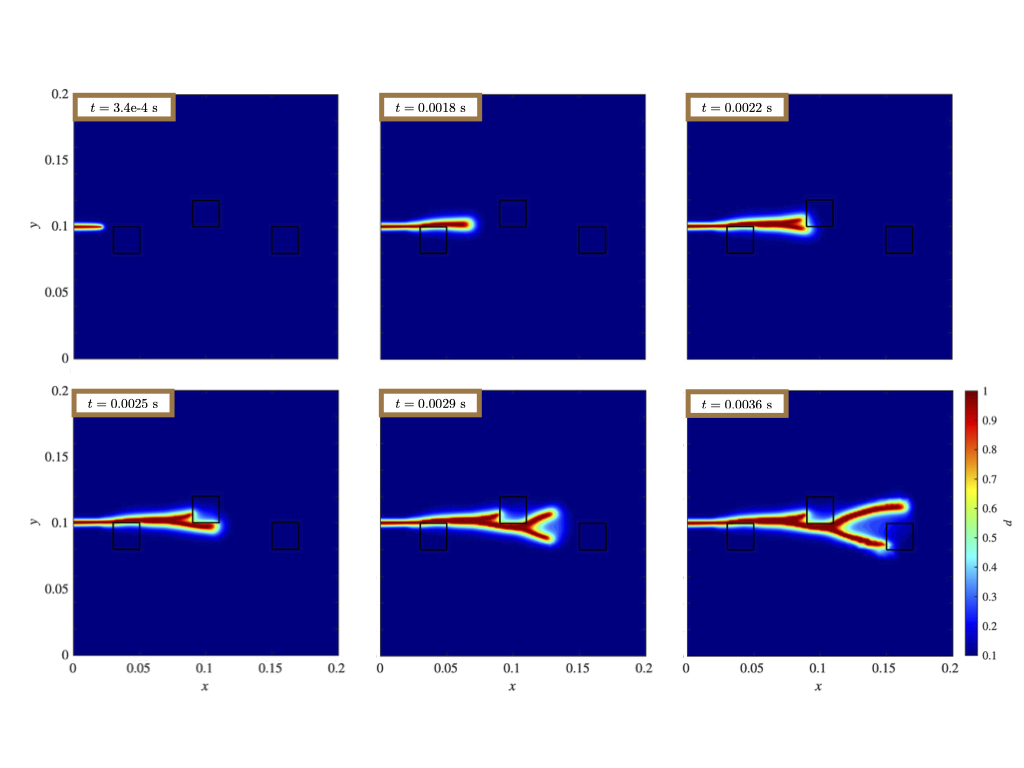
Our recent work has spanned efforts to ameliorate features of the VPF method to help determine proper crack initialization procedures, reduce excessive dissipation and crack widening seen in the original method, and work to closely approximate theoretical expectations from linear elastic fracture mechanics (LEFM) from a kinematic and energetic standpoint. Our future work in this area focuses on mode-II cracks, and properly capturing the dynamics of shear cracks using the VPF method. Ultimately, this work aims to extend VPF methods toward a robust framework for modeling dynamic shear rupture,
Additionally, our research focuses on a novel crack steering approach which can be applied to existing cracks in infrastructure, which works by selectively constraining the out-of-plane displacement field of a particular structural element. Through numerical simulations and analogous experimentation, we seek to understand the capabilities and mechanistic underpinnings of this new approach, which can work in homogeneous materials, and is a markedly different mechanism from conventional material-centered fracture resistance approaches based on inclusions, interfaces, or spatial variations in toughness applied in architected materials. Nevertheless, we are also investigating possibilities for further increasing fracture resistance in engineered materials using a combination of our nondestructive approach with a materials-centered one.
🔗 View Publisher DOI 📄 Download PDFE. M. del Castillo & L. Li. "Assessing variational phase-field fracture against LEFM predictions for crack-tip dynamics." International Journal of Solids and Structures, 2026
🔗 View Publisher DOI 📄 Download PDF