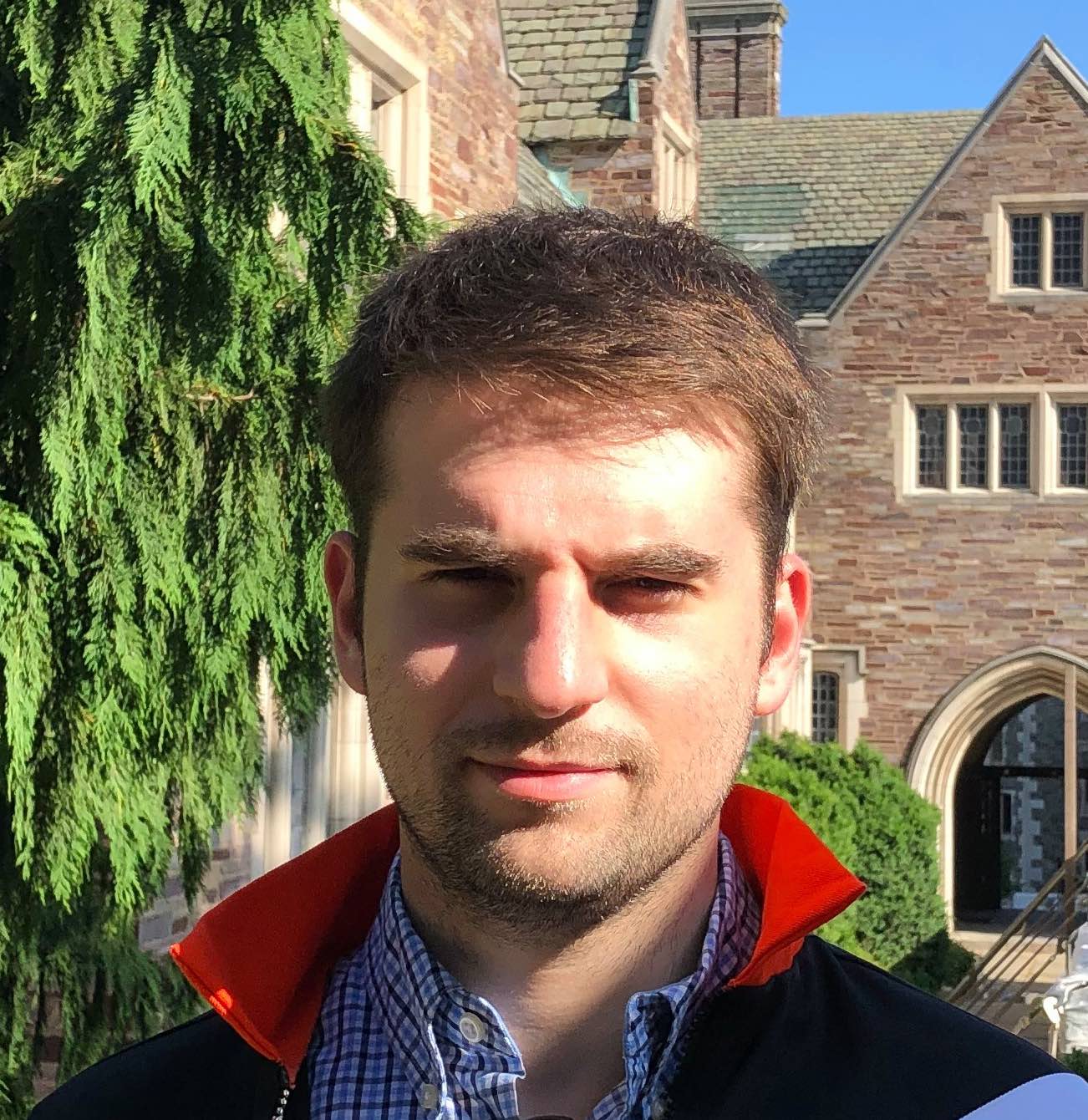
Welcome to the del Castillo Research Group at Northeastern University, led by Dr. Enrique M. del Castillo. Our objective as a research group is to further fundamental understanding of the mechanics and physics governing complex materials and geosystems, and harness this knowledge for solving engineering and geophysical challenges in relation to the built environment.
From a methodology standpoint, in addition to developing both mechanistic and data-driven computational methods, we use simulation and experimentation to probe and improve mechanistic theory, and create computational digital twins of geomaterials and earth structures. We utilize the computational resources from Northeastern’s Explorer cluster, located in the Massachusetts Green High Performance Computing Center (MGHPCC) and also steward the new Geotechnical and Sustainable Materials Laboratory space at Northeastern University, which will include modern material testing and geotechnical equipment, as well as high-velocity optical imaging for DIC analysis.
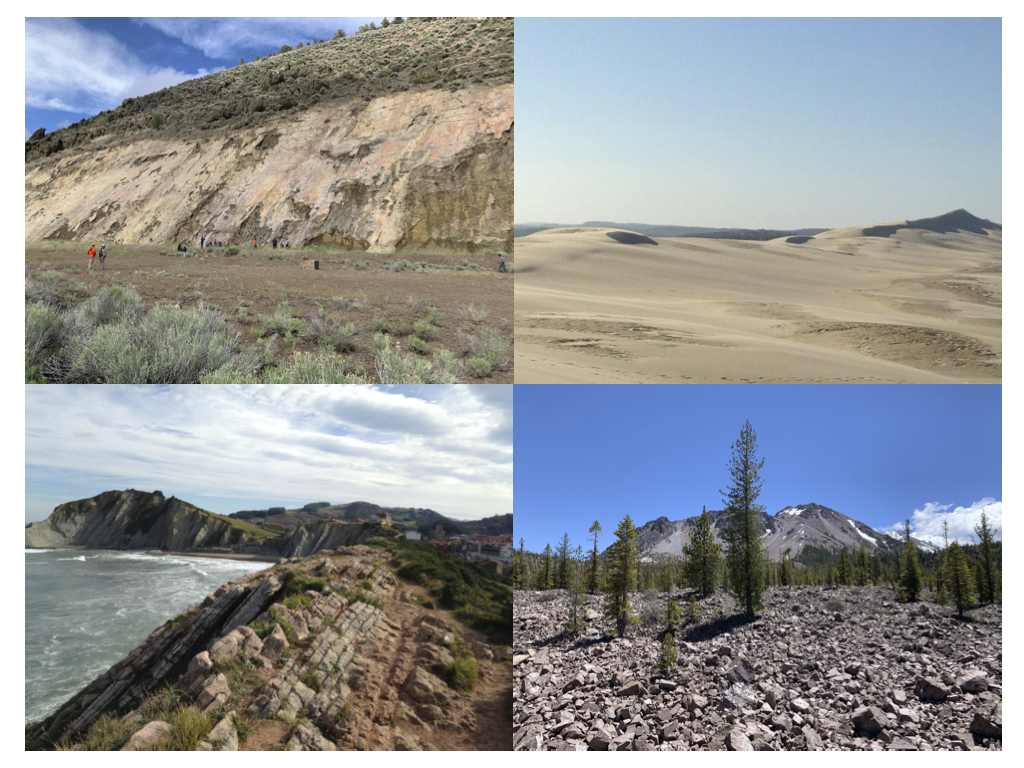
By complex materials we refer to both natural and engineered materials which exhibit heterogeneity, evolving microstructures, multiple phases, internal interfaces, nonlinear/inelastic behavior, localized failure and fracture, and coupled physical processes. This includes most geomaterials, porous materials, and granular media, which are the second most abundant type of material on Earth.
By geosystems we tackle problems spanning geomechanics, structural geology, geotechnical engineering, geophysics, and geohazards, where the mechanics of Earth materials governs processes across scales—from grain-scale interactions and localized deformation to faults, landslides, subsurface systems, and other large-scale geological and engineered systems.
We are currently recruiting two fully-funded PhD students to join our group. For more information please see the Opportunities tab. We also welcome inquiries from prospective postdoctoral researchers and other opportunities for collaboration. If our research interests overlap with yours, please feel free to reach out.
Overview of Research
The del Castillo Research Group focuses on four main interconnected research thrusts:
1. 🌍 Post-Failure Modeling of Natural Hazards and Engineered Structures
Failure initiation is often only the beginning - the subsequent large-deformation response ultimately governs the severity and extent of natural hazards. We develop meshfree computational methods, including based on smoothed particle hydrodynamics (SPH), that can handle the relevant large-deformation, as well as multiphysics or coupled hydromechanical conditions.
2. 🌋 Large-Deformation Structural Geology, Tectonics, and Volcanology
Understanding how deformation accumulates and reorganizes geological systems is central to explaining the emergence and evolution of large-scale tectonic and volcanic structures. Our research uses mechanics-based computational models to investigate these large-deformation processes and uncover the physical mechanisms that govern the evolution of geological systems.
3. ⚡ Geomaterials & Geomechanics for Sustainable Energy Infrastructure
We study the mechanics and failure characteristics of geomaterials relevant to energy storage, resource extraction, and sustainable energy infrastructure, with particular emphasis on the formation and evolution of compaction bands and faults from a bifurcation theory perspective, their influence on permeability and fluid transport, and their implications for subsurface applications such as carbon sequestration.
4. 💥 Nonlinear Mechanics and Physics of Dynamic Fracture
We study dynamic fracture, with particular emphasis on crack initiation, propagation, branching, crack interaction, and friction, as well as how stress waves and energy transport control the evolution of rapidly propagating fractures. We use both experimental and computational approaches, with particular emphasis on developing and improving phase-field fracture formulations and consider applications in engineered materials and structures as well as earthquake processes.
Put together, these areas of study help us understand the performance and, critically, the failure of materials as a dynamically evolving process—spanning the initiation and localization of deformation, the propagation and interaction of discrete fractures, and ultimately catastrophic collapse and large-deformation behavior.
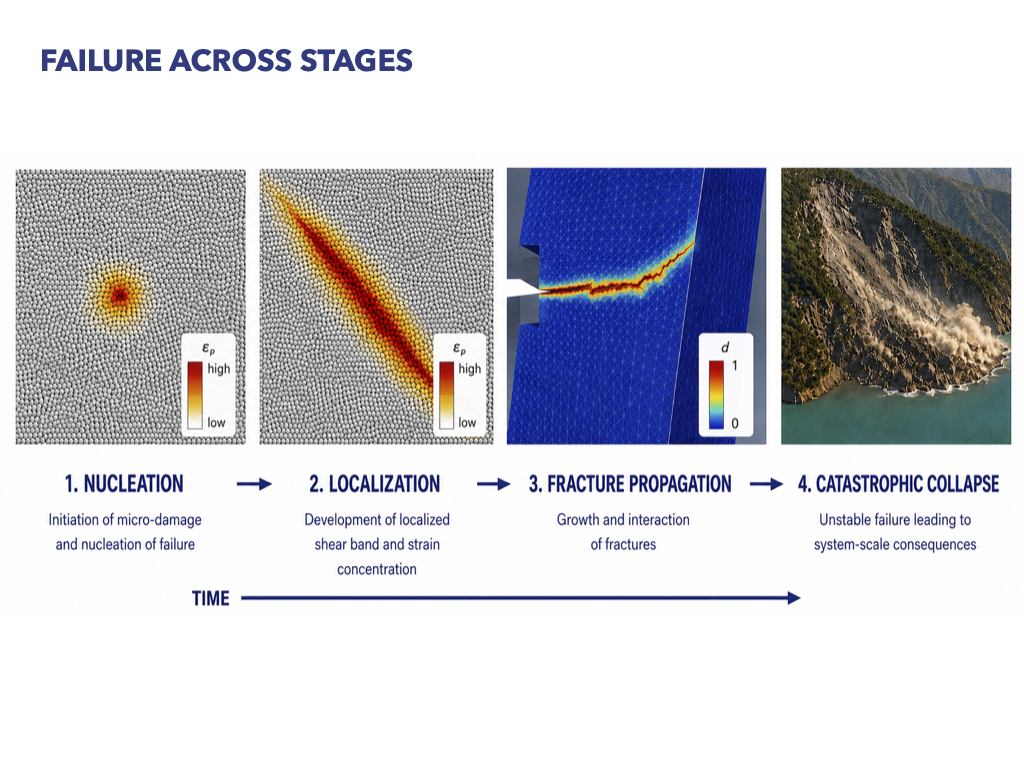
Likewise, we seek to understand and ultimately reliably predict material behavior and failure as an interconnected process across spatial scales, linking micromechanical processes at the grain scale to specimen-scale behavior, localization and fracture at the mesoscale, and lastly system-scale geotechnical, geological, and geophysical processes.
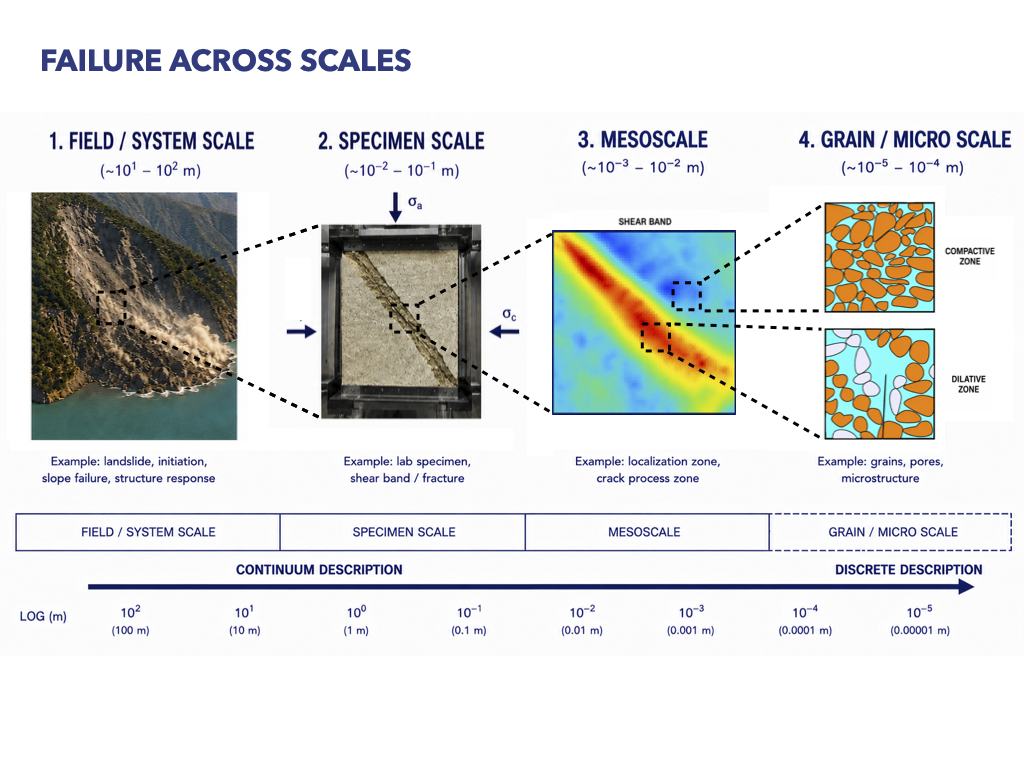
For more details, please check the Research Projects tab.
News
New paper published in Extreme Mechanics Letters
Our paper presenting a computational proof-of-concept of a novel noninvasive crack steering approach in structural members by way of lateral constraints, written with Prof. Liuchi Li (Princeton), was published in Extreme Mechanics Letters.
Click to see moreOur first paper published in IJSS
Our recent paper focusing on the ability of the dynamic variational phase-field fracture method to adhere to LEFM theory, written together with Prof. Liuchi Li (Princeton), was published in the International Journal of Solids and Structures.
Click to see moreOfficially joined Northeastern University as an assistant professor
I am excited to announce that I have oficially started as an assistant professor in the Department of Civil and Environmental Engineering at Northeastern University.
Click to see more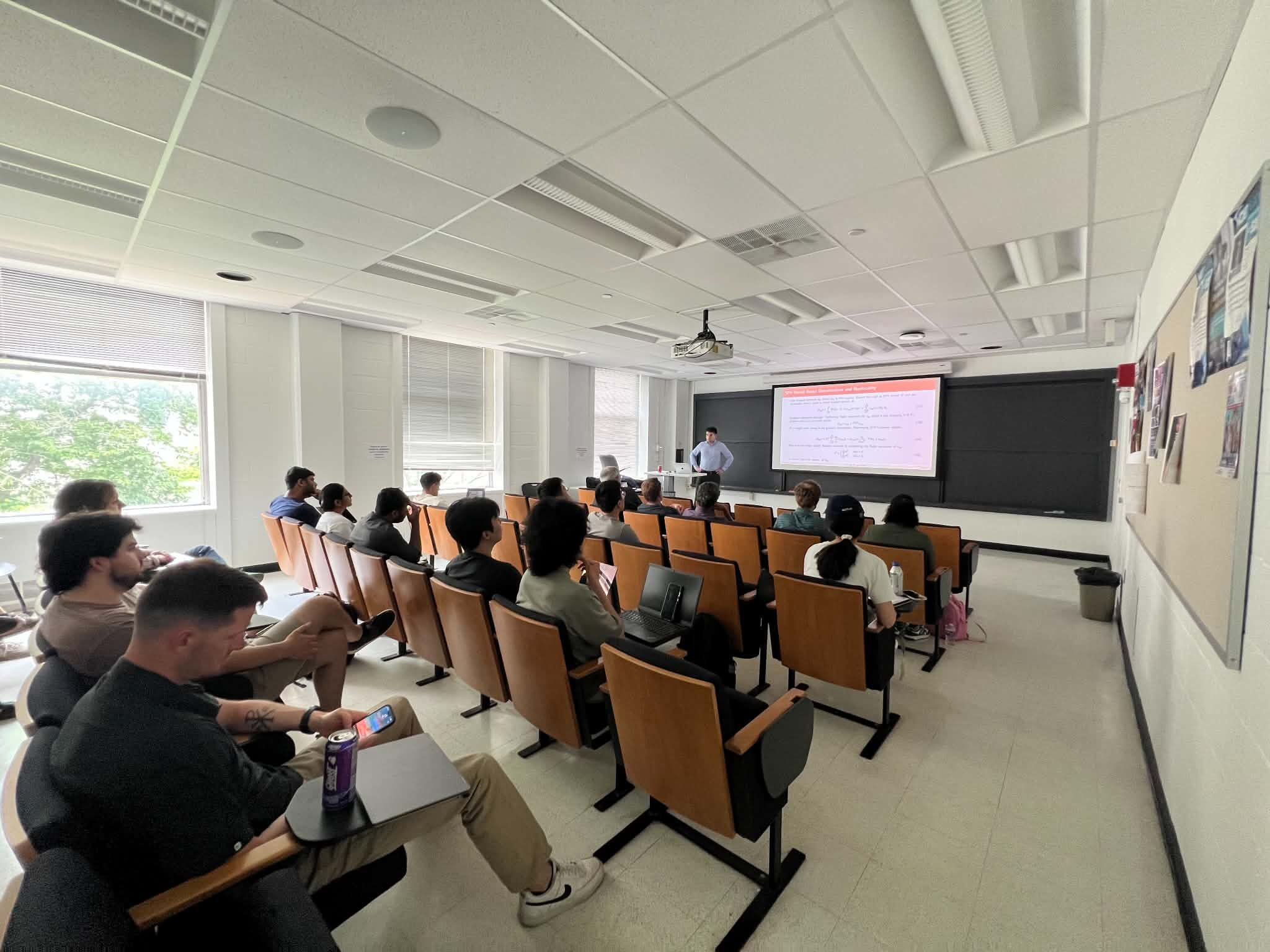
Gave the CEE department seminar at Princeton
Titled: "From Localization to Catastrophic Collapse: Computational Approaches for Failure in Complex Materials". Thanks to everyone that attended!
Click to see more